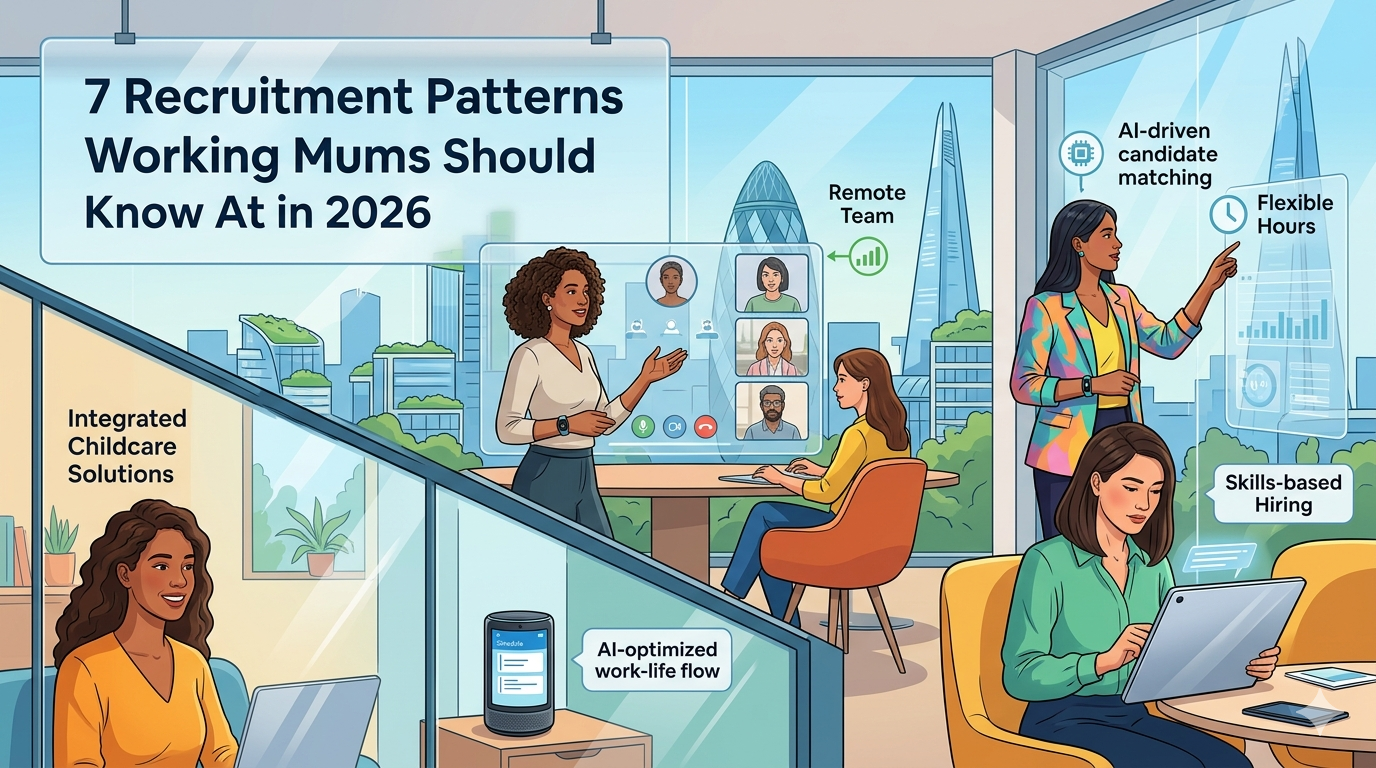
What is changing in UK hiring, and how mums can use these changes to find work that fits around real life.
The way employers recruit is changing.
Some of those changes may feel like extra hurdles. More technology. More competition. More pressure to tailor every application. But there are also changes that could genuinely help working mums, especially those returning after a career break, searching for greater flexibility, or trying to remain professionally ambitious without allowing work to consume their family life.
You may already know that flexible jobs exist. The bigger challenge is knowing what flexibility looks like in 2026, where to find it, and how recruiters are deciding who gets shortlisted. This is where understanding recruitment patterns becomes useful. You do not need to follow every job market trend. You simply need to recognise the changes that affect how you search, how you present your experience, and how you assess whether an employer will genuinely support the way you need to work.
Here are seven recruitment patterns worth knowing about in 2026.
1. Employers are starting to discuss flexibility earlier
For years, candidates were often expected to apply for a job, attend interviews, receive an offer, and only then ask whether flexible working was possible. That approach placed mums in an uncomfortable position.
Do you mention your availability early and risk being judged before your skills are considered? Or do you wait until the end and discover that the role cannot fit around your life? That is beginning to change.
More employers now recognise that flexibility can help them attract a wider and more experienced group of candidates. As a result, some job adverts are becoming clearer about remote working, hybrid arrangements, reduced hours, flexitime, compressed hours, and job sharing.
This matters because it allows you to make better decisions before investing time in an application. However, do not stop at the word “flexible”. A genuinely useful advert should tell you what the arrangement looks like. It may explain how many office days are required, whether start and finish times can change, whether reduced hours are accepted, or whether the role is open to job sharing.
When an advert simply says “flexible working available”, treat that as the beginning of your research, not the final answer. Check the employer’s careers page. Look at employee reviews. Search for flexible working policies. Prepare a clear question for the recruiter.
The pattern to notice is not that every job has suddenly become flexible. It is that employers are under greater pressure to explain flexibility earlier, and mums can use that information to avoid applying blindly.
2. Professional flexibility is becoming more visible
Many mums assume that asking for flexibility means lowering their salary expectations, moving into an entry-level role, or abandoning the professional level they worked hard to reach. The available data tells a more hopeful story.
Hybrid work remains particularly common in professional, managerial, technical, administrative, and higher-paid roles. This means flexibility is not limited to basic support jobs or junior positions.
For a skilled mum, this changes the search strategy. Instead of beginning with “part-time jobs near me” and hoping something relevant appears, begin with the professional role you are qualified to do. Search for your target job title first. Then add terms such as hybrid, remote, flexible hours, compressed hours, four days, job share, or reduced hours.
For example:
- Project Manager, flexible hours
- HR Business Partner, part-time
- Data Analyst, hybrid
- Marketing Manager, four days
- Operations Lead, job share
You may find that the flexible version of your profession is not advertised under “jobs for mums”. It is simply a professional vacancy with a different working structure.
This is especially important for mums returning after a career break. You do not have to automatically step backwards because your availability has changed. Your working structure may need to change. Your professional value has not disappeared.
3. Recruiters are paying more attention to skills
Traditional recruitment often placed heavy emphasis on job titles, degrees, continuous employment, and whether someone had followed a predictable career path. Skills-first hiring is gradually changing that.
More recruiters are searching for candidates based on what they can do, rather than relying only on their previous title or academic background. This can favour mums with career breaks, non-linear work histories, international experience, freelance work, self-employment, voluntary experience, or transferable skills gained across different sectors.
The opportunity is there, but your CV must make those skills easy to identify. Do not assume a recruiter will work out that your previous responsibilities involved stakeholder management, budgeting, data analysis, project delivery, customer retention, or team leadership.
Name the skill. Show where you used it. Add the result.
Instead of writing:
- Responsible for supporting projects and communicating with clients.
You could write:
- Coordinated five client projects, maintained weekly stakeholder communication, and delivered agreed milestones within schedule.
The second version helps the recruiter understand your capability without needing to interpret vague language. This is also why your LinkedIn skills section matters. Recruiters increasingly search for candidates using specific skills and tools. Your career story can be complex. Your positioning should not be.
4. AI is becoming part of the recruitment process
Not every employer uses artificial intelligence to screen applications, but technology is becoming more involved in recruitment. It may be used to distribute job adverts, search candidate databases, screen CVs, rank applications, schedule interviews, record interview notes, or identify skills.
This does not mean you should write your CV for a robot and remove every trace of personality. It means clarity matters more.
A highly designed CV with complicated tables, text boxes, graphics, and unclear section headings may be harder for some applicant tracking systems to interpret.
A general CV may also perform poorly because it does not contain the skills, terminology, or experience connected to the vacancy.
For working mums with limited time, the temptation is understandable. You find five jobs and send the same CV to all of them before your available window disappears. But a better approach is to keep one detailed master CV, then create a tailored copy for each serious application.
- Adjust your profile.
Move the most relevant experience higher.
- Include important skills from the job description where they genuinely match your experience.
- Use clear headings such as Professional Experience, Skills, Education, and Certifications.
- Keep the formatting easy to read.
Technology may influence the first stage, but a human still needs to understand your value. Your CV should work for both.
5. Returner programmes are becoming a real recruitment route
A career break does not always need to be hidden, defended, or treated like something that disqualifies you.
Some employers now run structured programmes specifically for experienced professionals returning after an extended break.
These opportunities may be called:
- Career returner programmes
- Returnships
- Relaunch programmes
- Return-to-work programmes
- Supported hiring
- Career comeback programmes
Returner programmes can include coaching, mentoring, training, technical updates, confidence support, and a structured route back into professional work.
They can be especially useful for mums who have strong experience but feel disconnected from recent industry practices, unsure about interviews, or worried that recruiters will focus too heavily on the gap.
These programmes exist across sectors including finance, technology, engineering, government, consulting, law, and professional services.
They are not all the same.
Some lead to permanent employment. Others are fixed-term. Some offer hybrid working, while others require specific office attendance. Eligibility may also depend on the length of your career break.
Read the details carefully.
The important shift is that more employers are beginning to recognise career returners as an experienced talent pool, rather than treating them as candidates who must start again.
When searching, do not only type your previous job title. Add terms such as “career returner”, “returnship”, “relaunch”, and “supported return to work”.
You may discover a route designed for the exact transition you are making.
6. Flexible work no longer means remote work only
Remote work receives the most attention, but it is only one form of flexibility.
A fully remote role can still require you to be available from 9am to 5.30pm, attend several daily meetings, and respond immediately throughout the working day.
Meanwhile, an office-based role with flexible start times, compressed hours, or a job-share arrangement may give you more control.
In 2026, mums should assess the entire working structure.
- Where will the work be done?
- When must you be available?
- Are there fixed core hours?
- Can the hours be reduced?
- Can the role be completed across fewer days?
- Are meetings kept within agreed working hours?
- Can start and finish times change?
- Is term-time working possible?
- How often must you travel?
This is why “remote” and “mum-friendly” should never be treated as the same thing.
The best arrangement depends on your life. One mum may prefer three predictable office days and two days at home. Another may need fully remote work. Someone else may prefer term-time hours, freelance projects, evening work, or a four-day week.
The goal is not to chase one popular definition of flexibility. The goal is to understand the control, predictability, location, workload, and availability expected, then decide whether that arrangement works for you.
7. Family-friendly culture is becoming easier to investigate
An employer can advertise flexible working and still have a culture that makes parents feel guilty for using it. This is why mums need to look beyond the policy.
Recruitment is increasingly being used to communicate an employer’s wider culture. You may now see job adverts and careers pages mention parent networks, wellbeing support, core meeting hours, enhanced parental leave, flexible start times, carers’ support, and returner initiatives.
These details can help you identify employers who have thought about family life before you arrive. You can also look for evidence during the interview process.
- Does the recruiter answer questions about flexibility clearly?
- Can they explain how the team currently works?
- Do senior employees work flexibly?
- Are meetings normally held within core hours?
- Is the advertised flexibility written into the contract?
- What happens when an employee needs to adjust their working pattern?
Remember that UK employees can request flexible working from their first day in a job. This is a right to request, not an automatic right to have every request accepted. That difference matters.
Where possible, it is still better to understand the employer’s position before accepting an offer, especially when a particular arrangement is essential for your family. The encouraging change is that flexible working conversations are becoming more normal. The smartest candidates will use those conversations to assess the employer, rather than assuming that any offer must automatically be accepted.
What these recruitment patterns mean for mums
None of these changes means the job search has suddenly become easy. The UK hiring market remains competitive, and many employers are being cautious about recruitment costs. Flexible roles can attract high application volumes because so many people want them.
But you are not powerless.
- You can use the changing market more strategically.
- Look for employers that describe flexibility clearly.
- Search for professional roles at your real level.
- Position your skills and achievements so recruiters can understand them quickly.
- Tailor serious applications instead of sending the same CV everywhere.
- Include returner programmes in your search.
- Assess the working structure, not just the job title.
- Ask direct questions before accepting an offer.
The goal is not to convince every employer to understand your life as a mum. The goal is to identify the employers, roles, and working arrangements that are already moving in the right direction.
How Mum Hours UK helps
Job hunting can easily become another unpaid job for a busy mum. You may spend hours moving between job boards, opening adverts that say “flexible”, and then discovering that the hours, location, or expectations do not work for you.
Mum Hours UK was created to reduce some of that searching. We research and curate flexible job opportunities across different sectors, bringing remote, hybrid, part-time, school-hour compatible, and other flexible roles into one place.
We are also building positioning and career support to help skilled mums present their experience clearly and compete confidently for the opportunities they find.
We cannot control an employer’s workplace or recruitment decision. But we can help you search with greater clarity, understand your options, and approach the process more strategically.
You are not asking for less of a career. You are looking for work that takes the full reality of your life into account.
Explore current flexible opportunities at mumhours.co.uk.